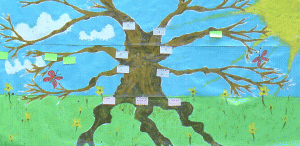
The People Behind SPN

Terry Bamford: Trustee


Terry Bamford OBE started his professional career in the probation service. He worked for BASW before moving into social services as Assistant Controller of Harrow Social Services. He was Director of Social Services for the Southern Health and Social Services Board in Northern Ireland, and Executive Director of Housing and Social Services in Kensington and Chelsea. He was Chair of Kensington and Chelsea PCT and a founder member of the General Social Care Council. He is a Board member of the Stonebridge Housing Action Trust and the Commonwealth Organisation for Social Work. He has also chaired the London Drug and Alcohol network. 

Raza Griffiths: Co-ordinator

Raza is a survivor who uses his experiences within the mental health system to inform his work as SPN Joint Network Co-ordinator.

Raza’s multiple mental health interests are reflected in the key role he has played in organising recent SPN study days on mental health and employment, spirituality, the White Paper Our Health Our Care Our Say and finally, recovery and diversity. He actively campaigned around the Mental Health Bill (now Act) and has now shifted his attention to the Act’s Code of Practice.

He is passionate about survivor representation and also diversity issues and is an experienced trainer who has delivered mental health and diversity training to the NHS, local authorities and Kent Police.

Outside SPN, Raza is the South East regional Co-ordinator for Open Up and is also an Expert Adviser for SHIFT. This continues his active involvement in stigma busting around mental health, which started when he was Training Officer at Media Bureau, a national survivor led project which delivered media skills training and support to over 300 survivors who got their voice heard in the national and regional media to challenge stigma and discrimination around mental health issues.  

When not juggling his three jobs, Raza enjoys cycling, swimming, meditation, eating and cooking and travelling in unusual locations.


Vicky Nicholls: Co-ordinator

Vicky is one of two joint coordinators at SPN. She also works as a freelance trainer and researcher in health and social care, specialising in spirituality and mental health. Prior to this she coordinated Strategies for Living II, a user-led research project, at the Mental Health Foundation, and a national Project on spirituality and mental health in partnership with NIMHE and Professor Peter Gilbert. As a new mum she experienced postnatal depression and is now the mother of a lively and thriving three year old with a particular interest in research and practice on issues around transition, parenthood and family wellbeing.

.

Tayo Richards - Executive Officer


Tayo has been a business administrator for over 11 years. Her career spans a number of sectors ie learning and development, training, retail, telemarketing, public health and investment banking. In the last 4 years she has set up two businesses that focus on delivering business support virtually. She is married with three children and lives in Herne Hill, London.

Alleyn Wilson: Co Chair

Alleyn started her career in secondary school teaching and has also worked teaching university social work. Her social work practice began in a general hospital, almost in the days of being an almoner. Since then she has worked in a variety of Social Services Departments in the North West becoming an Assistant Director before moving organizational boundaries to commissioning mental health for a PCT and then to work within CSIP in the south east, leading on suicide prevention , mental health promotion and social care.
Alleyn has been a member of SPN almost since its inception. She is passionate about the need to retain the skills and spread the understanding of the values, and perspective of social care within mental health services. She is a carer and fervently believes that  service users and carers are the experts in  care and so must drive all our thinking and planning, our changes and  our service delivery.
Alleyn is now formally retired but undertakes some occasional freelance work and spends much of her her time keeping slugs out of her garden. 

Jayasree Kalathil: Co Chair


Jayasree has spent a considerable part of her adult life trying to understand the six different psychiatric diagnoses given to her over 23 years, and negotiating western psychiatric interventions, alternative medicine and faith healing. The net result of this is that she has developed a strong political identity as a survivor, with clear views on the meanings of healing, recovery and resilience.

Jayasree has a Ph.D. from the CIEFL, Hyderabad, in literary/cultural studies. Her academic work on madness and mental health reflected her political work within the women’s movement, and started with researching women’s writing and the ways in which women used narrative spaces to talk about their distress. Subsequent work focused on media and cultural representations of madness, family and gender issues, and the rights of people with psychiatric diagnoses. Jayasree was the founding editor of aaina, India’s only user-led mental health newsletter.

After moving to England from India, Jayasree worked with the Mental Health Media and the Sainsbury Centre for Mental Health, before setting up as a freelance researcher. Currently she runs the website www.survivor-research.com, the main objective of which is to highlight the perspectives of service users and survivors from black and minority ethnic communities.

Making the views and opinions of people from black and minority ethnic communities an integral and critical part of the overall user/survivor voice has become a key focus of Jayasree’s current work. She believes that the Black survivor voice is caught between an inadequate focus on race and culture issues within the service user movement and user-led research, and an equally inadequate user leadership within initiatives that do focus on race related issues in mental health. This is an issue she explores in the report Dancing to Our Own Tunes: Reassessing BME Mental Health Service User Involvement.

In her non-mental health avatar, Jayasree fancies herself as a bit of a writer. Her book, The Sack-Cloth Man, a children’s novel, was published in January 2009, and has been translated into two Indian languages. Jayasree has published some of her poetry in international journals and also enjoy translating literary works from Malayalam, her mother tongue, to English.


Layo Afuape

Layo Afuape is an approved mental health professional and a practice assessor and is Head of Social Care for Mental Health Older Adults Directorate at South London & Maudsley NHS Foundation Trust. She leads social workers within this directorate across Croydon, Lewisham, Southwark and Lambeth.  She has worked in integrated mental health service in Southwark for over 9 years. Layo is currently the Lead for Safeguarding Adults and Mental Health Act for her directorate. She is currently a Practice Assessorand is writing a Carers Strategy for the Directorate. She was Team Manager for North Southwark Community Team for older adults, worked as a Bed Manager for her directorate and was a Service Manager for Southwark Community Services & Partnership. Layo trains on Ethics & values in caring for people with diagnosis of Dementia on a Dementia Course being facilitated by SLAM. She has a particular interest in training, mental health, safeguarding adults, service users/carers involvement and in promoting social models of working within health care setting.

Daisy Bogg


As a mental health social work professional, Daisy has discovered that one of the key areas of challenge is the promotion and representation of social models and perspectives across the range of provisions, and whilst the policy drivers and modernisation agendas are explicit in their commitment to recovery and person-centred care, how this is translated in practice in variable and dependent upon local interpretation and awareness.

 The main focus of Daisy's roles over the past three years has been championing social care and acting as consultant and advisor to healthcare organisations, in terms of the delivery of social care and social work services. She is academically active and her first book is due to be published in June 2008, this feeds into her area of expertise –the integration of social work and within the NHS.

The focus of all Daisy's work experience and professional development has been, and is, based around the development and delivery of the social model of mental distress, part of which has been membership of SPN. Over the past year she has become more involved with the organisation, including facilitating a workshop at one of the study days and organising a local forum event to promote the work of SPN.

Daisy has also spent the past year writing a social work text on integration of services within mental health care, due to be published in June 2008 with Learning Matters, and has authored a chapter in the upcoming AMHP resource book on dual diagnosis and the mental health act (due for publication September 2008). She is also currently in the initial stages of her doctoral research, considering meaningful ways to measure social outcomes for users of mental health services.

ROSIE BUCKLAND

Rosie is currently studying for her Masters degree in social work at Bristol and is particularly interested in the social and policy contexts that mental health social work operates within and how that relates to understandings of problems, interventions and responses. She hopes to work in adult mental health on qualifying as a social worker and has previously worked on a voluntary basis with women who have been in the psychiatric system.


She already has a Masters in cultural studies, during which she became particularly interested in how constructions and categorisations of gender and sexual identity become meaningful. She has drawn on these perspectives in understanding social work practice. She has worked variously in lesbian and gay politics and as a drug and alcohol worker in outreach and criminal justice custody settings in Westminster and Hackney. Her own previous use of mental health services has contributed to her commitment to understanding and promoting social perspectives with mental health and other social work services.


LAWRENCE BUTTERFIELD (Lol)

Lawrence is commonly known as Lol. He is a qualified mental health nurse since 1984 and worked within mental health services in the NHS for almost 30 years. The last 10 years has been at a senior level. He moved across to work as Social Inclusion Lead for Middlesbrough Council in December 2008. He is a voluntary member of the Speakers Bureau and has positively promoted mental health issues in schools, colleges. employment and the media through the Bureau. He is actively involved in the Time To Change campaign and has also been involved in the BBC Headroom campaign. He also submits a bi monthly column for the local newspaper on Teesside aimed at positive mental health awareness raising. He has done this for 5 years.


He is passionate about tackling stigma and discrimination and in 2006 was Highly commended by CSIP for 'Leadership in tackling stigma and discrimination'. He is very proud of this achievement. He experienced depression in 2005 and has since used his personal experience and extensive psychiatric knowledge to educate, normalise, and demystify all mental health issues. I am articulate, confident, hardworking and compassionate. He has presented at numerous conferences with the NHS, Middlesbrough Council, and CSIP.


He recently completed his autobiography 'Sticks and Stones' which covers his career in mental health services, his own mental illness, and the creative ways he has challenged inequalities, locally and nationally over many years.This is through Chipmunkapublishing.com a mental health empowerment publishing company. He tries to lead by example.


Randall Chan


Randall Chan has served on the SPN executive committee since 2002. He was first introduced to SPN through the second study day in November 2001, where
his eyes were opened to alternatives to the ultra-medical model. Randall has
subsequently been involved in carer-related issues locally and regionally. He
served for three years as Carer Advisor to the local Mental Health Trust Board.
He holds a Certificate in Mental Health Training, and has done training for
nursing students, ASWs, and interpreters. Randall is also involved with offering the recently issued Racial Equality and Cultural Capability training in the Eastern Region.

As a member of the CSIP-Eastern Experts by Experience steering group,
Randall has promoted a carer's perspective to several initiatives, such as
Improving Access to Psychological Therapies, Crisis Resolution/Home
Treatment, and Choice. He is especially proud of contributing to the
groundbreaking Payment and Reimbursement Policy (a part of Making a Real
Difference-MARD) which comprehensively addresses how to properly pay
service users and carers for their involvement.
As an trained interpreter, Randall has extensive contact with Chinese Mandarin
speakers needing assistance in health care, legal, and prison settings.
Randall is also keenly interested in spirituality and mental health through his
role as an ordained minister.

AMBER CHIDAKASHI

My name is Amber Chidakashi and I have lived with the condition "Bi-Polar Disorder" for 28 years, which means that my thought process can be illogical and fast paced.

I have overcome many of the social barriers to having a fulfilled life through a structured system of voluntary work, study and a very strong informal social support network.

In the past 15 years I have been very active in the voluntary including founder members of "Richmond Users Forum" and "Still Building Bridges" (a very successful befriending club)

I have also graduated from the Citizens Academy which is a training course put on by CSIP to train users on Self Directed Support and Personalisation.

I really feel that the SPN provides a vital link to the mental Health Community nationwide.

I have attended many conferences and study-days by SPNN and have accessed their skills and expertise in helping me to form my own group,” Taking Control", which provides skills and training in personalisation. I would be very valuable to the Social Perspectives Network as I am a recipient of Direct payments and a Consultant User on the Subject of Personalisation. I was a speaker at series of conferences where I spoke of my "Personal Journey" through Direct Payments.

I would like to help support conferences and study days based upon the skills and knowledge that I have in Personalisation as well as putting forward the idea of bringing local businesses on board. Our members will have more power and influence in their work with the local business community behind them. I would like to help the trustees and management to understand how to support members locally from a users/carers point of view by using pools of knowledge and expertise in groups that exists locally.

I am currently reading for an MA in Charity Management at St. Mary's University Collage in Twickenham which helps to demonstrate my commitment to the sector. I have been asked to be a trustee of Richmond Borough MIND and Richmond Users Independent Living Scheme (www.ruils.co.uk/application currently in process).

I also have a good understanding of business knowledge through my business study degree, experience of running my own business where I have received three testimonials from my clients (Telecom Plus, t/a The Utility Warehouse) for "amazing service" and have won Excellence in Volunteering from Richmond Council for Voluntary Service and Hounslow CAB. I successfully raised £1900 for a local befriending group and £3000 for the local Twickenham branch of the Bi-Polar organisation I recently had a £10,000 judgement "Set aside" when a client of mine failed to appear at a court hearing.

My hobbies include implementing appropriate use of technology small businesses, arranging days out which make a difference to my local community.

Promoted "Dolphin Island" Arts Based Social Club dedicated to overcoming isolation.

Active member of JCI London (jcilondon.org.uk) a local NGO dedicated to promoting Active Citizenship); part of a global network of 200,000 people.

Alumni member of BNI (Business Network International); an international Business Referrals Club, tasked with helping members find new business.


Sarah Carr


Sarah is a Research Analyst and Participation Advisor at the Social Care Institute for Excellence, leading some of the organisation's user participation and mental health projects. She is also managing a major workstream on the personalisation of social care services. She has worked for the National Institute for Social Work, Oxleas NHS Trust and at the Sainsbury Centre for Mental Health in research and information roles.

Sarah has also had a number of social care jobs including, a residential support worker at a farm hostel for homeless people in Edinburgh, a worker at a rehabilitation project for young women sex workers and an HIV and AIDS awareness trainer in Manchester. She is currently a trustee at PACE, (London’s leading charity promoting the mental health and emotional wellbeing of the lesbian, gay, bisexual and transgender (LGBT) community, and a Member of INVOLVE, the national advisory Group, funded by the Department of Health, which aims to promote and support active public involvement in NHS, public health and social care research. Sarah is a long-term user of mental health services and has written on her own experiences as well as general mental health practice and policy, service user empowerment and participation. Along with Jerry Tew, Sarah co-chairs the SPN/NIMHE Research Group.

NEIL CONNELLY

Neil Connelly

I am an ex-service (current? I don't like to get too hung up on the terminologies) of drug and alcohol, criminal justice, and social services. I am thirty-two years old, married, with three children, living a stable life. All of this was made possible when someone saw fit to give me a 'chance', at exactly the 'right time', so to speak.

I used that opportunity for everything it was worth, built up my life, and my self-esteem etc.. Then pushed forward, doing what I love the most, which is helping others, and taking a keen interest in the systems and structures that those people may be subject to, and survive within. This work ethic lead me to voluntary posts, in supporting role, in two separate therapeutic communities for substance addiction recovery, where I learnt the skills of working with individuals face-to-face, in group settings, through a range of psychosocial interventions.

Being just as interested in the policy side of the drug treatment field, I began attending service user groups, and policy steering groups in my local area of Lancaster. I took a side-step into a 'generic' kind of service user and carer advisory group, based in the Department of Social Work, at the University of Central Lancashire (UCLAN), where I sat as a group member for over two years alongside individuals representing a whole spectrum of need across the social care sector.

The group, known by its acronym of 'SUCAG' (Service User & Carer Advisory Group)(http://www.uclan.ac.uk/health/schools/school_of_social_work/sucag.php), really worked hard in its effort to align itself with the Department proper, led initially by good guidance, the chair of the group at the time, Dr. Annie Huntington, but soon after, led by us, the members themselves. Almost all aspects of the design and delivery of the social work degree at Preston were open to, and regularly discussed by SUCAG. As a group, we delivered literally dozens of workshops, seminars, interviews, and even planned and delivered three separate, consecutive congresses, celebrating the good work carried out over the year by the group, and highlighting gaps in the curriculum and training process for the students.

After approximately a year into my SUCAG membership, I was contacted by the National Institute of Health and Clinical Excellence (NICE), who asked me to become involved in the national guideline 'Drug Misuse: Opioid Detoxification' (http://www.nice.org.uk/guidance/index.jsp?action=byID&r=true&o=11633), launched in July 2007. I joined the Guideline Development Group as a Service User representative, where I worked alongside the rest of the group for almost two years, developing a guideline for the drug treatment field. My involvement in that particular guideline was one that I would describe as invaluable, for a plethora of reasons, not least because it gave me the opportunity to work alongside many dedicated, professional and welcoming people, the majority of which did their absolute best to rise above the often experienced tokenistic elements of service user input, enabling me to enjoy the experience, not to mention challenge, of participation, as opposed to rubber-stamping their previously held ideas and directions, rather, I was able to not only join in, as it were, but also contribute some original work that was published exactly how I wrote it.

Following completion, and launch of the drug guideline, NICE asked me to join them on another development, the NICE national guideline on Antisocial Personality Disorder and its treatment. Again, I was involved for a lengthy period with another team, whom I worked alongside for about 18 months, until its launch in January of this year (http://www.nice.org.uk/guidance/index.jsp?action=folder&o=41533).

I have also had experience ad-hoc lecturing at UCLAN for a while, about issues such as stigma, institutionalisation, and parental substance misuse, focussing heavily at the time on debates sparked by papers like Hidden Harm. I have written, produced and delivered group and individual awareness-raising sessions around substance use and its 'benefits and harms', for young people in a Pupil Referral Unit. I've had a few years experience working as a mentor for children and young men in custodial care, with a view to resettlement in the community.

Currently, I am coming to the end of a social work degree at Lancaster University. I have had experience, through placement, to work within a voluntary sector organisation that worked closely with the community in which it is based to provide multi-agency resources to service users, where I was charged with tasks such as creating, developing and encouraging individuals to sustain service user groups, and designing and carrying out, within a group, a piece of small-scale social research programme, as art of a wider community development initiative.

I have been aware of the Social Perspectives Network for some time now, and support the work of the people involved, mainly by attempting to retain and develop my own perspective, and skills, in relation to how I approach my work, and those I work with, hopefully in a humanistic way.

I would like to be considered as a candidate to receive support to contribute as a service user please.


Vicki Coppock


Vicki is a Reader in Social Work and Mental Health at Edge Hill University.  She is also a qualified and experienced psychiatric social worker with 16 years experience teaching critical perspectives on mental health, childhood and gender and sexuality at undergraduate and postgraduate levels.  Her research and publications focus on the critical analysis of theory, policy, legislation and professional practice in the field of mental health, with a particular emphasis on asserting a positive rights agenda for children and young people in mental distress.

Vicki is passionate about her subject and about making a difference to professional practice in the mental health field.  She left University in the mid 1980s armed with her certificates and head full of psychiatric and psychological knowledge; ready to help all those unfortunate 'disturbed' people she had read so much about.  But during her journey working as a psychiatric social worker in a very deprived area of Merseyside she discovered something very important.  Vicki discovered that the way she had been trained to understand and respond to people in mental distress just didn't square with the reality of their lives and began to question the many different labels we professionals use and interventions we deem necessary.  She became much more interested in listening to what people in mental distress say is important to them - not just what we professionals believe to be 'in their best interests'.

Suman Fernando

 
Suman Fernando is Honorary Senior Lecturer in Mental Health at the European Centre for the Study of Migration & Social Care at the University of Kent and Visiting Professor at London Metropolitan University, London. He was a psychiatrist in Enfield for over twenty years and served on the Mental Health Act Commission chairing its National Standing Committee on Race and Culture until mid 1990s. He has written and lectured widely on issues of racism and cultural diversity in mental health and social care.

RUKSHANDA ESAT

Info to be supplied shortly.

Peter Ferns


Peter has run his own training and research consultancy for many years and has wide experience of working in the public sector, and with voluntary and not-for-profit organisations. He has been a consultant to government departments on policy and procedure formulation in health and social services. Peter specialises in service development, equality issues, strategic organisational change and evaluation with a focus on service user-led audits. He has completed several practical research projects such as the recent BME mental health census and developing race equality and cultural capability materials for NIMHE as well as various initiatives to develop participatory approaches to the design and delivery of mental health services with BME service users and communities. Peter has also worked in Australia on leadership and teamwork in the commercial sector and has published several articles, book chapters and training materials on organisational change, emotional health and equality issues.

Rowena Harding - Trustee


Having served as the Network's first coordinator and as part of the executive group, Rowena now focuses her efforts on being the one of the trustees for the network.

She has a background in marketing and communications in both the corporate and not-for-profit sector and has also worked on developing organisational, marketing and business development strategies for small charities. Her work has mostly been in the field of social care, learning disabilities and homelessness.  
Rowena is particuarly interested in mainstreaming mental health issues, the role of media in stigma and discrimination and improving understanding of mental health amongst the public. She is particularly keen to see non-governmental organisations and charities be more efficient, effective and profitable in working with governments and delivering services

Nick Hervey

Nick Hervey is a social worker by professional background and is Head of Social Care in the Integrated Mental Health Service in Southwark. He has worked in local mental health services for over 25 years. He is currently responsible for developing services for users and carers, for volunteering, the implementation of Equalities, and for taking the Mental Health and Mental Capacity Acs forward in the Southwark Directorate of the South London and Maudsley Trust. He is the Social Care Lead for the South London Hub of the UK Research Network and has a research interest in work with carers, mental health promotion and the development of user led services. Nick has a special interest in the history of psychiatry, having completed a PhD on the History of the Nineteenth Century Lunacy Commissioners, and is a Trustee of the Bethlem Museum and Archives. He has published various books and articles on the history of mental health and on current day practice, including most recently an article on the development of user led services in Mental Health Today.

MASHFIQUI JOY ALAM

Info to be supplied

JACQUI LOVELL


As a member of developing partners (dp), a social enterprise led and run by people with long term mental health needs, I work with people who experience multiple layers of stigma and discrimination and who are socially excluded, many of whom live in poverty. I love my job and the life I have chosen for myself.

I am committed to working in anti-oppressive ways and am glad that dp operates as a co-operative because I struggle with power differentials, so for me equality works best. I love the diversity I get in working with people from diverse backgrounds, cultures, faiths, spiritualities, sexualities, ages and countries and I feel most at home when I am with people who have survived (or are attempting to survive) life’s experiences.

As a gay woman and a mother to a growing family I am aware of the ways in which people can be pushed out whether inadvertently or not the result is the same. I prefer to adopt a human rights approach in all that I do and to go out and meet with the most vulnerable people first because if we get things right for them then it follows that they will be somewhere near ok for the rest of us.

I admire Paulo Freire and his educational approaches and the work of Ignacio Martin Baro when he talked about the need to turn the whole of psychology on its head and to adopt a bottom up approach to what we do and for these reasons I am working using community and liberation psychology principles and practice.

As a person in my own right I bring with me my lived experiences of trauma and survival and the years I spent raising my own awareness in order to live a different life to the one that may have been mapped out for me.

I would bring all of the above to the Social Perspectives Network and would aim to share and disseminate what the Network does with the other people with whom I live and work in the North East of England and beyond.


Jeanie Molyneux


Jeanie’s background is in social work, having worked for 20 years in both community and hospital settings. She always had a particular interest in mental health and also worked as an Approved Social Worker.

Jeanie is currently a lecturer in social work at Northumbria University in Newcastle. Her special interests include promoting the active participation of people who use services and carers in the education and training of social workers and health care workers, interprofessional working, particularly in championing the value of the social model within health care settings, and most recently in encouraging the use of the arts and creative strategies in the education of social workers. For seven years she was co-ordinator of the Approved Social Work training programme in the north east. In this role, Jeanie took the initiative in seeking to develop service user and carer involvement across this training programme, making active and ongoing links with local service user and carer groups. As a result of this she also became one of the patrons of Launchpad, a service user led group in Newcastle.

Jeanie has been a committed member of SPN, almost from its inception in 2002. She was delighted to find SPN, feeling that it met the concerns many social workers were having that their skills, and the social model of mental health could be overtaken by medical approaches to mental health. In 2005 she helped to found the SPN group in the north east, which meets about 3 times a year, with speakers on a range of topics.


JANE SHEARS

I have experience of working in residential care, hospitals and the community having been employed by local government, universities, charities, specialist mental health Trusts and primary care Trusts. I spent a number of years working with mental health service user groups in central and Eastern Europe on two Lottery-funded projects.

I continue to practise as an Approved Mental Health professional but most of my work is now focussed on managing a primary care mental health service called the Changing Minds Wellbeing Service. The service is recovery-focussed and employs a minimum of 33% of people with a lived experience of mental distress or experience as a carer. I also manage the Increasing Access to Psychology Therapy programme locally.

I co-chaired the New Ways of Working for Social Work workstream with Terry Bamford and have represented social work on a number of Department of Health committees and developments.

Changing Minds also designs and delivers a wide range of education and training as I see service and workforce development as crucial partners in effective service delivery.

I have always been a strong advocate of SPN and would welcome the opportunity to contribute to the network in a more active capacity.


Patsy Staddon

Patsy Staddon is a survivor of the alcohol and mental health treatment services. She self-medicated with alcohol till she was 44 then found, on meeting up with supportive lesbian women, that she didn’t need it. She still went for treatment, to be on the safe side, but experienced it as following an agenda of social control as opposed to self-discovery and healing. She still suffers from epilepsy and severe anxiety. She returned to university, where she is currently completing her PhD in  ‘the sociology of women’s alcohol use and its treatment: a survivor’s perspective’. From her research has developed  WIAS, a small independent social group for women who have or have had alcohol problems.

She has been a member of Shaping Our Lives, the national Service User organisation, for several years, and is a member of INVOLVE’s Empowerment Group. She is currently the West Hub service user representative of the UKMHRN, and advises a number of organisations about alcohol issues as they affect women in general and lesbian/bisexual women in particular.

She believes passionately in the right of all people to self-determination, a social approach to mental health and substance use, and achieving better understanding of the values of alternative families.

Jerry Tew


As a founder member of SPN, I have contributed to the development of the organisation as broad alliance of people (service users, carers and professionals from any disciplinary background) who are interested in promoting social perspectives in mental health. 

I have particular interests in research, teaching and learning and the future direction of social work.  I edited the book Social Perspectives in Mental Health which was launched in 2005 and I have co-ordinated the SPN Research Group which has collectively written a Position Paper on Values and Methodologies that was launched in 2006 in collaboration with CSIP and SCIE.  I have also contributed to the drafting of the joint SCIE / CSIP / RCPsych Position Paper on Recovery which was launched last year.

I am a senior lecturer in social work at the University of Birmingham with over 20 years' experience as an Approved Social Worker, manager and training officer within Social Services Departments and the voluntary sector.  I have particular interests in social theory, empowerment, mental health and service user involvement, and I am the Social Care Lead for the Heart of England Hub of the Mental Health Research Network.

Mike Young

Mike is a senior mental health services manager with Kirklees Social Services Department in West Yorkshire.  His service is integrat ed formally with the South West Yorkshire Mental Health NHS Trust  to whom he is seconded for one day a week as Associate Director of Social Care. He believes the social care model  should  have a major impact on the future development of mental health services. He feels the 'voice' of social care within integrated mental health services needs to be heard clearly  and  be valued . Mike thinks there has been a lack of leadership at a national level amongst social care professionals and he thinks it is vital that SPN  continues promoting the fundamental importance of social care in all aspects of modern services.


More about SPN

Who are behind SPN?
Workplans
Contact us
Join SPN
SPN Papers

Home | Privacy policy | Terms and conditions | Printer friendly
Site built by Net Efficiency Ltd

Social Perspectives Network Home | About us | Contact us | Site map | Join us

About Us

Who are SPN?

Workplans

Research Group

Contact us

Join us

Tue 9 Feb 2010